
Does your college student really need renters insurance if you already have homeowners insurance?
It depends on where your student lives, what your homeowners policy covers, and how much you could afford to pay out of pocket after a loss. However, for many families, GradGuard’s renters insurance policy is a more practical choice for two specific reasons.
GradGuard’s renters insurance has a deductible as low as $100, compared with a typical home insurance policy that starts at $1,000. A high deductible reduces the value to zero if a student's $600 bike is stolen.
No risk of a premium increase if you file a claim. Filing a claim for a student away at college may lead to increased costs on your primary home insurance.
While a parent's homeowners insurance may provide some protection (typically 10% of the property coverage of your home insurance policy. , that coverage can have limits when a student lives away from home. A separate renters insurance policy can provide another way to protect your student's belongings and provide personal liability coverage while they are at school.
Before move-in day, here's what parents should know about homeowners insurance, renters insurance and the coverage a college student may need.
Does Homeowners Insurance Cover College Students?
The answer depends largely on where your student lives.
Students who live in a dorm may have coverage under their parents' homeowners or renters insurance policy, particularly if they are full-time students and remain part of the household. However, the amount of coverage may be limited. The Insurance Information Institute notes that homeowners policies commonly provide off-premises coverage for students living in dorms, while the specific limits depend on the policy.
The situation can be different for students living off campus. A student renting an apartment or house may not be covered under a parent's homeowners policy, depending on the policy and the student's circumstances. The National Association of Insurance Commissioners recommends that parents check with their insurance company or agent to determine whether their policy extends to an off-campus living situation.
Even when a homeowners policy provides coverage, there are several factors parents should consider.
Your Deductible Can Affect the Value of Your Coverage
A homeowners insurance deductible is the amount you pay toward a covered loss before the insurance company pays its portion.
For example, imagine your student's $1,200 laptop is stolen and your homeowners deductible is $1,500. Because the value of the loss is below the deductible, you would not receive a claim payment for the laptop.
A separate renters policy may offer a lower deductible. Plans designed for college students, such as GradGuard Renters Insurance, offer a standard $100 deductible for personal property coverage, although available options and policy terms can vary.
Coverage Limits Can Matter, Too
Homeowners policies can limit how much coverage applies to belongings kept away from the primary residence. The specific limits vary by policy.
Consider what your student is taking to college and how much it would cost to replace those belongings. A laptop may be the first item that comes to mind, but the total value can add up quickly once you include a phone, tablet, headphones, clothing, textbooks, furniture, sports equipment and a bicycle.
Start by creating an inventory of your student's belongings, including purchase information and photos, before they leave for school. Keeping that information in a secure location can also make it easier to document a loss if you need to file a claim.
Dorm or Apartment: Why Your Student's Housing Matters
Where your student lives can change their insurance needs.
Living in a Dorm
A student living in a dorm may have some coverage under a parent's homeowners or renters policy. Parents should find out how much coverage applies, what deductible they would face and whether the policy provides the type of protection they want for their student's belongings.
It is also worth asking whether the policy covers personal property at replacement cost or actual cash value. That distinction can affect how much your family receives after a covered loss.
A separate student renters policy can provide another option for families who want coverage specifically designed for students living on or around college campuses.
Living Off-Campus
Off-campus housing presents a different situation.
A student renting an apartment or house may need their own renters insurance policy, particularly if they are not covered under their parents' homeowners policy. Some landlords and property management companies also require renters insurance as a condition of the lease and may specify a minimum amount of liability coverage.
It is also important to understand what the landlord's insurance covers. The landlord's policy generally protects the building and the owner's property. It does not provide coverage for the student's personal belongings. If a covered fire or other event damages a student's laptop, clothing or furniture, the student's own insurance is what may provide protection for those belongings.
What Does Renters Insurance Cover?
Renters insurance can provide several types of protection that are relevant to college students.
Personal Property
Personal property coverage can help pay to repair or replace covered belongings if they are damaged, destroyed or stolen as a result of a covered event.
For a college student, that might include a laptop, smartphone, headphones, clothing, textbooks, bicycle, gaming system or furniture.
Many renters policies also provide some protection for belongings away from the student's residence, although the details depend on the policy.
Personal Liability
Liability coverage can help protect your student financially if they are found legally responsible for accidentally injuring someone or damaging someone else's property.
For example, a student could accidentally trigger a sprinkler system in a residence hall or cause damage to a neighboring apartment. Depending on the circumstances and policy terms, personal liability coverage may help with covered damages and legal defense.
Liability coverage can be particularly important for students living off campus because landlords may require a specific liability limit as part of the lease.
Additional Living Expenses
Some renters insurance policies include additional living expenses coverage. If a covered loss makes a student's apartment temporarily uninhabitable, this coverage may help pay certain additional expenses while they are displaced.
The amount and types of expenses covered depend on the policy. Additional living expenses generally apply to the increased costs a policyholder incurs because they cannot live in their home following a covered loss.
Coverage for Belongings Away From Home
College students take their belongings with them. A laptop may go from the dorm to the library, a bicycle may be locked outside a classroom and clothing and electronics may travel home during school breaks.
Some renters policies provide coverage for personal belongings away from the insured residence. Student-focused renters insurance often features worldwide personal property protection—an ideal benefit for those studying abroad—helping safeguard against covered losses according to policy terms and limits.
Replacement Cost vs. Actual Cash Value
When comparing insurance policies, ask how the policy values your student's belongings after a covered loss.
Actual cash value takes depreciation into account. An older laptop, for example, may be worth considerably less today than what you originally paid for it.
Replacement cost is designed to pay the cost to replace a covered item with a comparable new item, subject to the policy's terms, limits and deductible.
Consider a laptop that originally cost $1,400. If it is several years old when it is stolen, an actual cash value policy may base the claim payment on its depreciated value. A replacement cost policy may provide more toward purchasing a comparable replacement.
For students who depend on their laptops and other electronics for coursework, research and communication, that difference can affect how much a family has to pay out of pocket after a loss.
GradGuard Renters Insurance includes replacement cost coverage for covered personal property. GradGuard's current example shows a $800 replacement cost for a laptop, less a $100 deductible, resulting in a $700 claim payment. Actual claim payments depend on the policy and circumstances of the loss.
What Should Parents Look for in a College Renters Policy?
If you're considering a separate renters policy for your student, compare more than the monthly price. These five questions can help you evaluate the options.
1. How much personal property coverage does the policy provide?
Estimate what it would cost to replace your student's belongings. Include electronics, clothing, furniture, textbooks, bicycles and other items they are taking to school.
2. What deductible would apply?
The deductible is the amount you are responsible for before the insurance company pays a covered claim. A lower deductible generally means less out of pocket after a covered loss, while a higher deductible can reduce the cost of the policy.
3. Does the policy provide replacement cost coverage?
Find out whether the policy pays based on the depreciated value of an item or the cost to replace it with a comparable new item.
4. How much liability coverage is included?
Check the policy's liability limit and compare it with your student's lease requirements if they live off campus.
5. Does coverage extend beyond the residence?
Students take their belongings with them to class, the library, home and while traveling. Check whether the policy provides coverage away from the student's residence and understand any applicable limits or exclusions.
Why We Recommend GradGuard for College Students
For parents who want a renters insurance policy designed specifically for college students, we recommend GradGuard Renters Insurance.
GradGuard Renters Insurance includes student-focused features such as a starting $100 deductible for personal property coverage, replacement cost coverage and worldwide personal property coverage, subject to policy terms and limits.
The policy also includes personal liability coverage, with available limits ranging from $25,000 to $300,000. Students living off campus can check their lease or ask their property manager about the required liability limit.
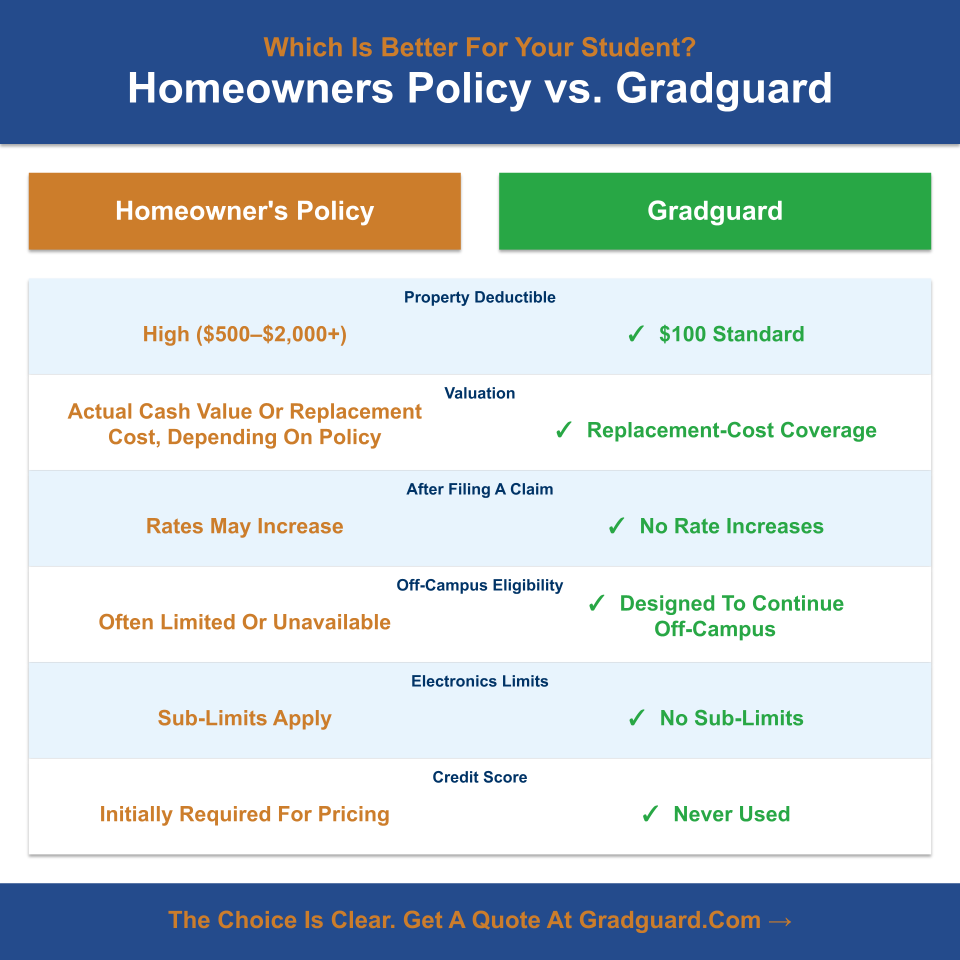
GradGuard also offers features that account for the college experience. For example, on-campus students receive the same price regardless of their credit history, according to GradGuard's current policy information.
The goal is to give students and their families a straightforward way to address risks that come with living away from home, whether that means a stolen laptop, damage to another person's property or a covered loss that affects their living situation.
Give Your Student the Protection They Need
Before your student heads to campus, take a few minutes to find out what your homeowners insurance actually covers. Ask whether your student is covered where they live, how much protection applies to their belongings, what deductible would apply to a claim and whether their belongings are covered at replacement cost.
If your student is moving into an off-campus apartment, find out whether they need their own renters insurance policy to satisfy the lease and provide personal liability protection.
If your homeowners policy does not provide the protection you want for your student, a separate renters insurance policy can provide coverage designed around their living situation and belongings. For parents looking for a student-focused option, GradGuard Renters Insurance offers personal property, liability and other protections designed for college life, subject to the policy's terms and limits.
Get a quote from GradGuard before move-in day.
